Choosing Primary and Secondary Conveyor Belt Cleaners
2026-09-30 10:02:15
Carryback costs money in three separate places: the material you have already paid to move ends up on the ground, someone is paid to shovel it, and the buildup it leaves behind ruins return rollers and pulleys. A belt cleaner is the cheapest intervention in that chain, yet it is frequently the last thing specified and the first thing neglected. Getting the type and the blade material right is most of the work.
Primary Cleaners: Removing the Bulk
The primary cleaner sits at the head pulley, on the discharge side, right where the belt leaves the pulley. Its job is to remove the great majority of adhered material. Because it works against the belt on the pulley face, it has the advantage of a rigid backing surface behind the belt — the pulley itself.
Blade material is the main decision. Polyurethane blades are the general-purpose choice: they wear well, they do not corrode, and they are gentle enough for most belt covers. Tungsten carbide blades last much longer on abrasive material but are harder on the belt and considerably more expensive; they earn their place on high-tonnage abrasive lines with vulcanised splices. Steel blades are largely obsolete except on specific heavy duties.
Mounting matters as much as the blade. A spring-loaded or torsion-arm mount keeps contact pressure roughly constant as the blade wears, which is why cheap fixed cleaners stop working within weeks.
Secondary Cleaners: Dealing With What Is Left
Whatever the primary cleaner misses passes on, and that residual film is what coats return rollers. The secondary cleaner is mounted just behind the belt as it leaves the head pulley, usually on the return run below the pulley, working against the belt in the opposite orientation to the primary.
Secondary blades are typically thinner and set at a steeper angle, since they are removing a film rather than a layer. They take less load and wear more slowly. On conveyors with a chronic carryback problem, adding a properly specified secondary cleaner is often a bigger improvement than upgrading the primary.
Brush and Rotary Cleaners
Brush cleaners use a rotating cylindrical brush running against the belt, driven either by a motor or by contact with the belt itself. They suit dry, powdery materials — cement, fly ash, fertiliser, sinter fines — where a blade would struggle because the material behaves more like dust than paste.
They are also useful where the belt has mechanical fasteners, since a brush passes over a fastener without catching. The limitations are that brushes wear, they are less effective on wet sticky material, and at high belt speeds the brush surface speed becomes a design constraint.
Splice Type and Belt Speed Change the Answer
Two belt characteristics decide what you can fit. The first is the splice. A vulcanised splice presents a smooth surface and will pass any cleaner. A mechanical fastener is a physical obstruction; a blade set hard against the belt will catch it and damage both. If the belt uses mechanical fasteners, the cleaner must be set with a small clearance or specified as a fastener-compatible design.
The second is belt speed. Above roughly 3.5 to 4 m/s, blade contact pressure and heat generation become design considerations, and the cleaner needs to be rated for the speed rather than simply fitted. Most cleaner failures on fast belts trace back to a unit specified for a slower duty.
Mistakes That Shorten Blade Life
The common one is over-tensioning. Setting a blade far harder than needed does not clean better — it accelerates blade wear, generates heat, and damages the belt cover. Correct practice is to set the minimum pressure that gives a clean belt and let the spring mount do the rest.
The second is ignoring the discharge chute. If cleaned material falls straight back onto the belt or packs up behind the cleaner, the blade is working in a bed of its own carryback and wears from abrasion on both sides. The cleaner and the chute have to be considered together.
Finally, cleaners need inspection. A blade that has worn past its useful point stops cleaning long before anyone notices, because the piles under the conveyor grow slowly.
Sourcing and Customisation
Cleaner frames are rarely a stock fit. Pulley diameter, chute geometry, belt width and available mounting structure all vary between conveyors, which is why customised cleaner assemblies are common on retrofit work. A manufacturer that fabricates cleaner frames as well as supplying blades can build to the actual site dimensions from a sketch or site photos.
Give the supplier belt width, belt speed, splice type, material characteristics and whether the cleaner is primary or secondary. Those five items are enough to specify correctly.
References
Conveyor Equipment Manufacturers Association (CEMA), Belt Conveyors for Bulk Materials, 7th Edition, 2014.
ISO 5048:1989, Continuous mechanical handling equipment — Belt conveyors with carrying idlers — Calculation of operating power and tensile forces, International Organization for Standardization.
ASME B20.1-2021, Safety Standard for Conveyors and Related Equipment, American Society of Mechanical Engineers.
MSHA, Code of Federal Regulations, Title 30, Part 56 — Safety and Health Standards for Surface Metal and Nonmetal Mines, U.S. Department of Labor.
DIN 22101:2011, Continuous conveyors — Belt conveyors for loose bulk materials — Basis for calculation and dimensioning, Deutsches Institut für Normung.
Author: Michael Trent — Technical Content Team, Conveyor Components Division
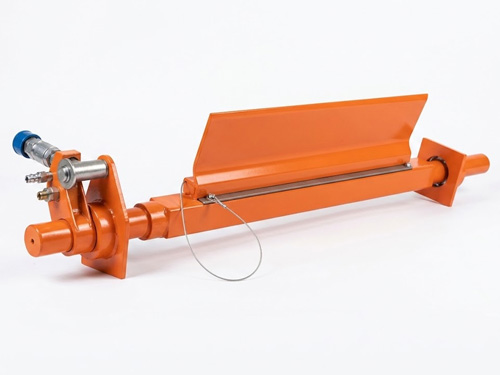
Heavy-Duty Primary Belt Cleaner Heavy-Duty Primary Belt Cleaners are robust conveyor belt c...
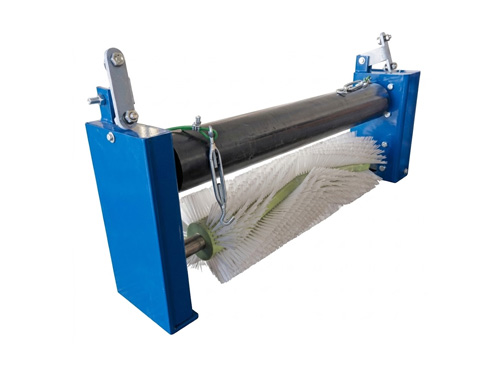
Self-Driven Rotary Brush Belt Cleaner Self-Driven Rotary Brush Belt Cleaners are specialize...
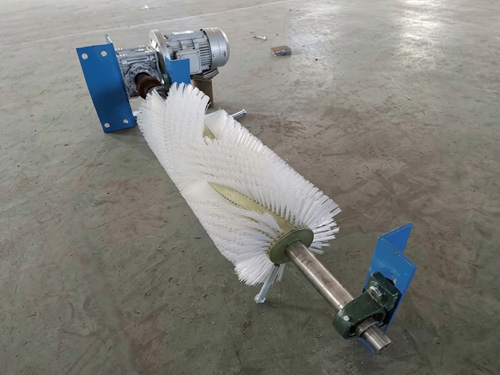
Brush Belt Cleaners in Various Models Brush Belt Cleaners are specialized conveyor belt cle...
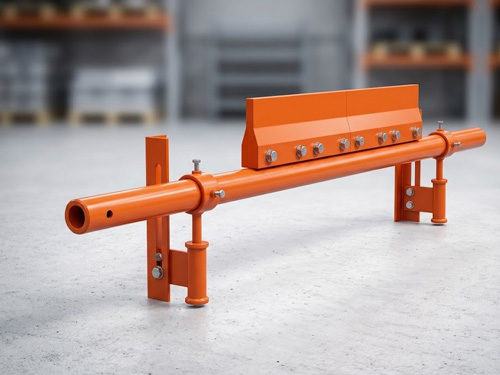
Secondary Conveyor Belt Cleaner Secondary Conveyor Belt Cleaners are designed to remove res...